What Is American Wagyu? An Honest Rancher's Guide
"Eating is an agricultural act."— Wendell Berry
Walk into any grocery store, scroll any online butcher, and you will see the word Wagyu stamped on everything from $200 steaks to gas-station beef sticks. It has become one of the most powerful words in food and, quietly, one of the most abused.
So before we ever ask you to put our beef on your table, we think you deserve a straight answer to a simple question: what is American Wagyu, really? Not the marketing version. The honest one — the kind a rancher gives you across a fence line, not the kind a billboard shouts at you.
This is that answer.
What "Wagyu" Actually Means
The word is simpler than the mystique around it. Wagyu translates roughly to "Japanese cow." It refers to a handful of cattle breeds developed in Japan over centuries and bred, with almost obsessive care, for one trait above all others: intramuscular fat, better known as marbling.
For generations, these cattle were working animals. The same genetics that helped them store energy as fine threads of fat throughout the muscle — rather than in a thick rind around it — turned out to produce the most tender, richly flavored beef in the world. The Japanese spent decades protecting those bloodlines, tracking lineage the way other countries track racehorses.
That heritage is real, and it is worth respecting. But it has also created a great deal of confusion for the person simply trying to buy a good steak. Because "Wagyu" on an American label and "Wagyu" in a Japanese auction house are not always the same thing.
Japanese Wagyu vs. American Wagyu
Here is the distinction that clears up most of the confusion.
Japanese Wagyu (Full-Blood)
This is beef from cattle that are 100% Japanese Wagyu genetics, with documented lineage tracing back to Japan. At its peak — graded A5 on Japan's scale — it is almost unbelievably rich. The marbling is so dense that a few ounces is a full experience, more like foie gras than a traditional steak. It is extraordinary, expensive, and, frankly, not what most people want as their everyday cut of beef.
American Wagyu
Most beef sold in the United States as "Wagyu" is American Wagyu— and the great majority of that is a cross between Japanese Wagyu genetics and American cattle, most often Angus. This is not a shortcut or a knockoff. It is its own category, and a deliberate one.
The cross does something smart: it keeps the prized marbling and buttery texture of the Wagyu line while bringing back the deep, beef-forward flavor and structure of American Angus. Pure Japanese A5 can be so rich that it overwhelms; well-raised American Wagyu gives you that melt-in-your-mouth quality and still tastes like a steak you'd be proud to grill for people you care about.
In plain terms: Japanese Wagyu is the rare special-occasion indulgence. American Wagyu is the beef you can actually build a table around.
Marbling Is the Whole Story
If you remember one thing, remember this: with Wagyu, the fat is not the enemy. The fat is the point.
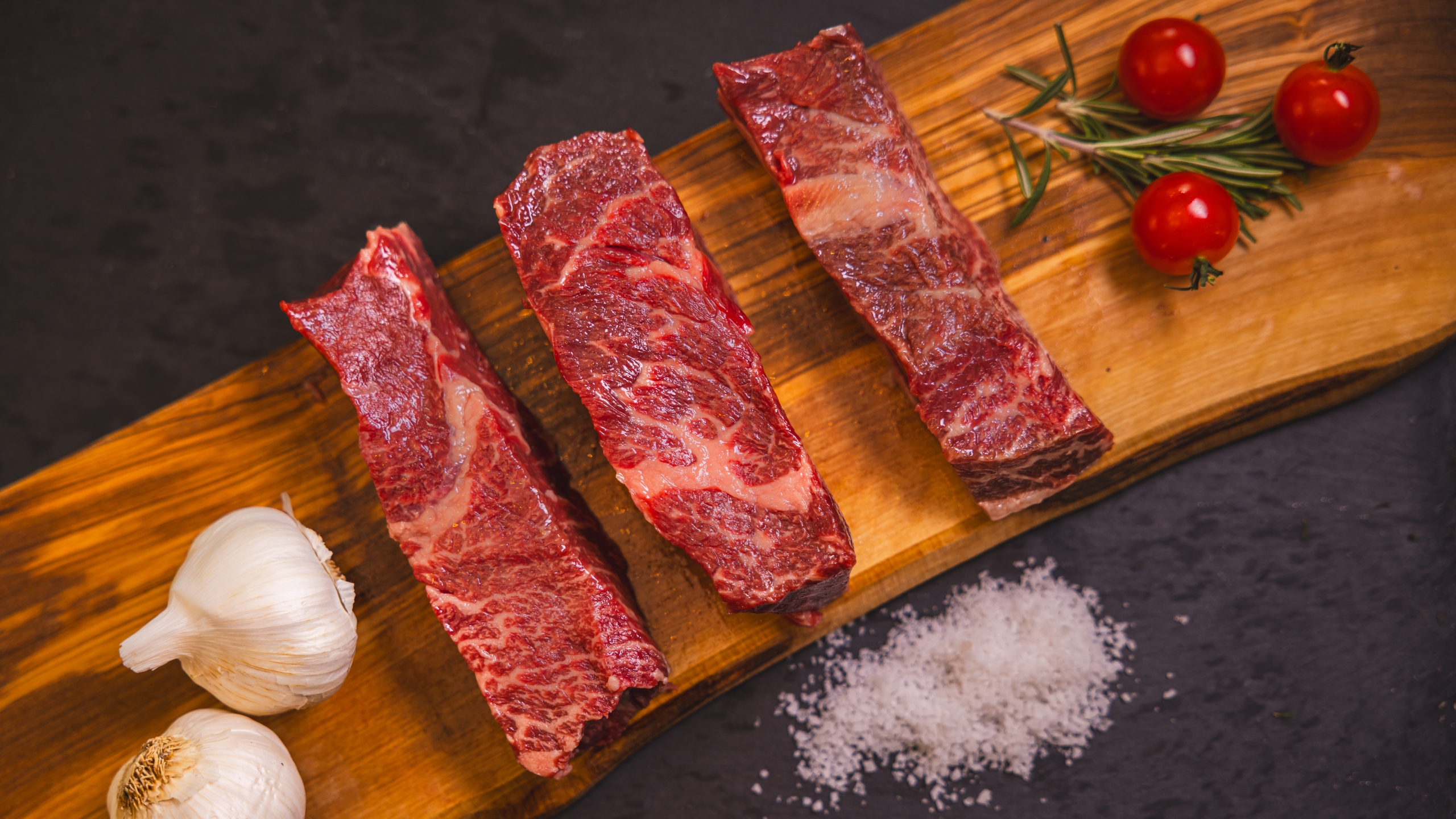
Marbling refers to the fine, web-like threads of fat woven inside the muscle. As the beef cooks, that fat renders — it melts and spreads through every bite — which is what creates the tenderness, the juiciness, and that signature buttery finish. Lean beef can be excellent, but it cannot do that. The marbling is what separates good beef from beef people remember.
There is a quality difference in the fat itself, too. Wagyu fat tends to be higher in monounsaturated fats — the same family of fats found in olive oil — and it has a lower melting point than ordinary beef fat. That is the reason a true Wagyu cut seems to soften the moment it hits heat, and the moment it hits your palate.
Both the United States and Japan grade beef largely on this trait. The USDA's top grade, Prime, represents the most marbled beef in the conventional American supply. Quality American Wagyu generally sits above Prime — more marbling than the best steak in most grocery cases, without crossing into the almost-too-rich territory of the highest Japanese grades. That window is exactly where we like to live.
Why "Wagyu" on a Label Can Mean Almost Anything
This is the part most beef companies would rather not put in writing, so we will.
In the U.S., "Wagyu" is not a tightly policed term the way you might assume. A product can carry the name with only a small fraction of actual Wagyu genetics. Some "Wagyu" beef sticks, burgers, and bargain steaks contain just enough to justify the word on the package — and a price that has very little to do with the beef inside.
That does not make every crossbred product dishonest. A 50% Wagyu cross, raised well, can be genuinely excellent. The problem is not the percentage. The problem is when the word is used to hide the truth instead of telling it.
So here is what an honest buyer should actually ask, whether you're buying from us or anyone else:
Where was this animal raised, and by whom? A real answer has a name and a place attached to it.
How was it fed and finished? Diet shapes flavor more than almost anything.
Who processes it, and to what standard? Quality is either protected through the whole chain, or it isn't.
Can they tell you all of this without dodging? Transparency is the tell. People hiding nothing tend to say everything.
If a seller can't or won't answer those, the price of the "Wagyu" on the label is the least of your concerns.
How We Raise American Wagyu at Dizzy Creek
We can answer every one of those questions, because we built the ranch to be able to.
Dizzy Creek Craft Beef is raised on our private Nebraska ranch by Shane Lechtenberg and his family — people who treat cattle as a craft rather than a commodity. From the start, our cattle are fed mineral-rich sea salt as part of their diet. Those trace minerals support the animals' health and immune function, and they deepen the flavor in every cut we send out. It is a small detail that tells you how we think about the whole process: get the foundation right, and the quality takes care of itself.
That philosophy is where our name comes from —we give the salt, you bring the sear. We do the slow, unglamorous work of raising the animal right. You get to be the one who cooks something unforgettable.
From there, every cut is processed to USDA standards by partners who share our standards, then packed with intention and delivered direct to your door. No mystery blends. No mass-market middlemen. No corporate beef plant where your steak is one anonymous unit among millions. Just beef you can trace from our pasture to your plate — which is exactly how it should be.
Is American Wagyu Worth It?
Worth is a fair question, and it deserves an honest answer rather than a sales pitch.
American Wagyu costs more than commodity beef because it is more — more marbling, more care, more time, and a genetic line that took generations to build. If your goal is the cheapest protein per pound, this isn't it, and we'd never pretend otherwise.
But that's not what our customers are buying. They're buying the meal they cook for their family on a Sunday, the cut they put in front of guests they want to impress without saying a word, the confidence of knowing exactly what they're serving and where it came from. For the people who set the table — who take that role seriously — that's not an expense. It's the standard.
If you want to taste the difference for yourself, the easiest place to start is one of our curated bundles or beef shares—a quarter, half, or whole—and let the beef make its own case.
The Gentry Take
There's a reason this kind of knowledge matters beyond the kitchen. Knowing what you serve — actually understanding it, being able to explain it, refusing to be fooled by a label — is a quiet form of respect. Respect for the people at your table, for the animal, for the land it came from, and for the rancher who raised it.
That's the whole idea behind The Gentry: not performance, not status, but the steady habit of doing ordinary things well and honestly. Choosing your food with care is one of the simplest, most overlooked ways a person shows what they value.
So the next time someone hands you a steak and calls it Wagyu, you'll know exactly what to ask. And when you serve ours, you'll know exactly what you're putting on the table — down to the pasture it grew up on.
That's not just better beef. That's beef worth gathering around.
